 Written by
 The Federal Government and the International Fund for Agricultural Development (IFAD) have opened a capacity-building workshop for federal and state stakeholders on accessing and deploying climate finance under the Value Chain Programme in Northern Nigeria (VCN), a $158.15 million intervention targeting up to 3.6 million smallholder farmers across nine northern states.
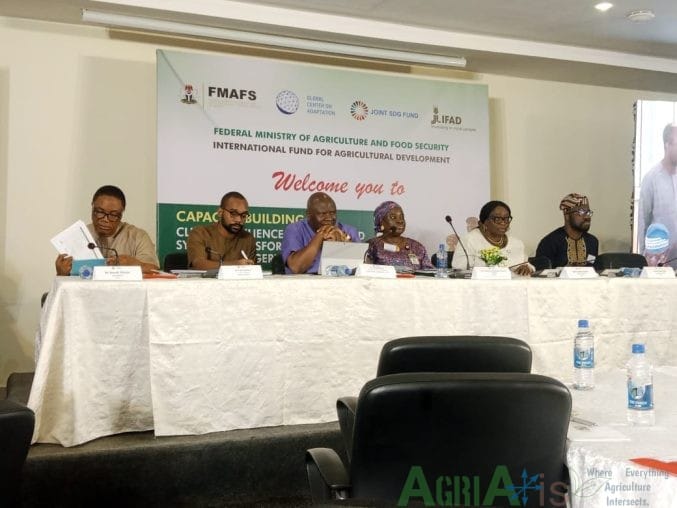
The workshop, titled “Capacity Building on Climate Resilience for Agri-food Systems Transformation in Northern Nigeria,” was held in Abuja and organised by the Federal Ministry of Agriculture and Food Security in collaboration with IFAD, the Global Centre on Adaptation (GCA), and the Joint SDG Fund.
This follows a high-level stakeholder engagement held two weeks ago where federal and state officials aligned on the accelerated start-up of the programme.
Ms. Dede Ekoue, IFAD Country Director for Nigeria, told participants that the training’s purpose is to move stakeholders from general awareness of climate risks to practical, coordinated action.
She was direct about what happens when programmes skip the foundational step: “Our interventions cannot be based on guesswork. They must be anchored in Climate Risk and Vulnerability Assessment,” she said.
The CRAVA framework, as she described it, identifies the most fragile landscapes and vulnerable crops so that every naira committed under VCN targets climate-proofed interventions rather than activities that climate shocks will simply undo.
The VCN covers nine northern states: Bauchi, Borno, Jigawa, Kano, Katsina, Kebbi, Sokoto, Yobe, and Zamfara, and is co-funded by IFAD and the French Development Agency (AFD), implemented by the Federal Government in collaboration with participating states.
The programme is designed to strengthen inclusive, climate-resilient, and nutrition-sensitive agricultural value chains, covering the full agricultural chain from production and processing to distribution and waste-to-wealth activities.
Mrs. Olubunmi Iluromi, Director of the Federal Department of Development Partners Projects at the Federal Ministry of Agriculture and Food Security, told the workshop that climate change is no longer a future planning variable for northern Nigeria. Droughts, floods, heat stress, and land degradation are already disrupting the agricultural calendar across the region, and VCN’s interventions must be designed with that as the baseline, not as an afterthought.
She also framed the broader institutional challenge. Accessing climate finance is not only about submitting funding applications. It requires institutional readiness, credible investment planning, and demonstrated results that justify further support. “Mobilising climate finance is not only about accessing resources,” she said, “but also about strengthening institutional readiness, improving investment planning and demonstrating results that attract further support.”
Dr. Oluyede Ajayi, Global Lead for Food Security at GCA, said his organisation brings technical assistance and climate risk analytics into large-scale agricultural investments. Under VCN, that includes climate-resilient livestock systems, improved crop production, agroforestry development, and digital climate advisory services for farmers who currently make planting and harvesting decisions without reliable weather information.
Ms. Ekoue was clear about the sequencing: VCN’s initial funding provides the first wave of climate-resilient investments. Sustained, scaled impact depends on climate finance that the programme’s early results must attract. “By integrating CRAVA-led adaptation, we are de-risking Northern Nigeria for future large-scale climate financing and demonstrating that our value chains are sustainable and economically viable,” she said.
The VCN programme was signed in May 2025 at the Presidential Villa in Abuja, where Vice President Kashim Shettima described it as a declaration of faith in the North as a place of abundance, and confirmed that the Federal Government would deploy digital tools to track farmer registration, market access, input distribution, and yield data across the nine states.
The climate finance workshop marks the practical phase of implementation beginning in earnest, with institutions and technical teams now being equipped to deliver outcomes that have been planned since the programme’s design phase in 2023.