
 Written by
 The Federal Government and the German development agency GIZ has launched a $2.2 million readiness assessment on Monday, May 4, in Abuja.
The essence of this launch is to audit soil degradation across Nigeria’s 774 local government areas and guide public spending on soil restoration ahead of the 2026 budget cycle.
The assessment is the operational arm of the Nigerian Farmers Soil Health Scheme (NFSHS), a programme that has been in development since 2023 but is now entering its first nationwide data-collection phase.
Sen. Aliyu Abdullahi, Minister of State for Agriculture and Food Security, said the readiness assessment would identify degraded soils, gaps in soil testing access, and capacity constraints in delivering soil advisory services nationwide.
The numbers behind the launch are sobering. At least 33 per cent of Nigeria’s soil is already degraded, and it may take up to 1,000 years to regenerate just two to three centimetres of soil. This according to the International Trade Administration (ITA).
The country loses about 24 million tonnes of topsoil annually due to erosion and land degradation.
The minister warned that without action, Nigeria cannot meet the targets in its Nationally Determined Contributions, its National Agriculture Technology and Innovation Policy, or its National Agriculture Resilience Framework.
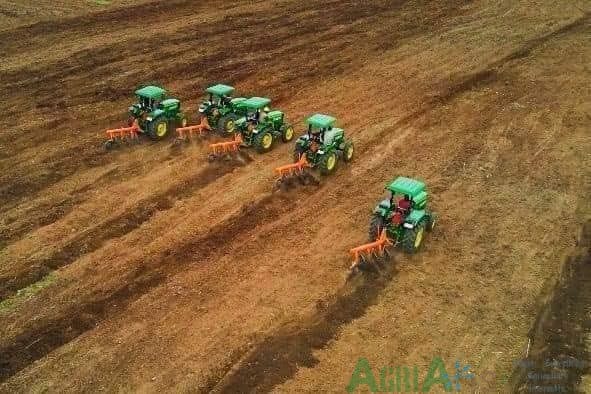
The scheme’s full implementation targets are specific. About five million hectares would be managed using improved soil practices, including organic fertilisers, lime application, cover crops and agroforestry systems. Digital Soil Health Cards would be distributed to farmers across all 774 local government areas using mobile technology.
The government is also targeting 10 million farmers receiving soil-test-based advisory services by 2027, with 36,000 youth and extension agents trained as certified Soil Doctors.
The project is financed by the Gates Foundation, commissioned globally by the German Federal Ministry for Economic Cooperation and Development, and implemented by GIZ in partnership with the Federal Ministry of Agriculture and Food Security.
The government, in collaboration with GIZ and other development partners, had already rehabilitated about 166,000 hectares of degraded land and trained over 280,000 smallholder farmers in integrated soil fertility management across several states.
GIZ project manager Mr. Alexis Brakhan said the initiative was designed to support Nigeria’s ambition of building a coordinated, data-driven soil management system capable of translating policy into practical support for farmers.
He noted that more than 17 organisations, including government institutions, researchers and private sector players, were already participating in a “Coalition of the Willing” established to promote information sharing and evidence-based soil health management.
The productivity case for the scheme is direct. The scheme has the potential to raise rice yields from 60 to 80 bags per hectare to 120 to 160 bags, while wheat and maize outputs could double from 50 to 100 bags per hectare. Onion yields are expected to increase from 400 to 800 bags per hectare. (World Bank)
What the readiness assessment must now establish is whether state-level infrastructure, laboratory capacity and extension systems can actually absorb those targets.
Twelve soil laboratories have been installed across the six geopolitical zones so far. Reaching 774 requires a rollout pace the sector has not demonstrated before. The assessment results, expected to guide the 2026 budget allocation, will show how wide that gap is.

Mentions