 Written by
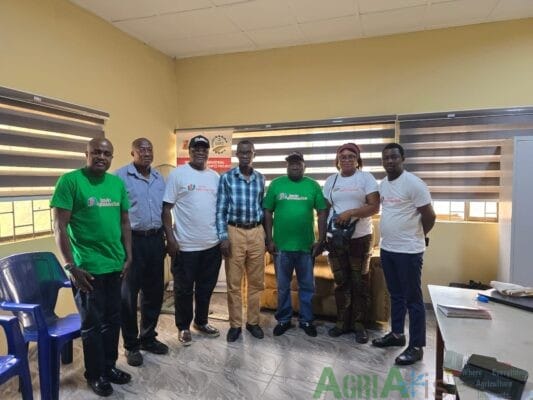
 The promoters of the Iseyin Agric Value Hub arrived at the Oyo State Agribusiness Development Agency (OYSADA) office in Ibadan on April 28, 2026, with a pitch for private sector-led agribusiness. What they left with was a different kind of conversation, one about security architecture, water supply, land ownership structure, and investor protection mechanisms.
That list tells the real story.
Mr. Lukman Komolafe, the chief executive officer of Lukom Integrated Services Ltd and promoter of the hub, described the project as a private sector-driven agribusiness cluster designed to aggregate farming, processing, and logistics along a single coordinated value chain. The hub sits at kilometre five along Iseyin Road and is being developed to attract investors, support farmers, and reduce the operational risks that have historically kept capital away from Nigerian agriculture. But securing OYSADA’s backing was not optional. It was the meeting’s central purpose.
The OYSADA delegation, led by Mr. Ajetumobi Akinwumi, Director of Technical Services, alongside Mr. Popoola Olusola, Regional Manager for Oyo, and Ms. Omotunde Oluwatobi, received the presentation and expressed the agency’s readiness to collaborate. Both parties committed to further engagement. No investment figure was announced. No timeline was signed.
What emerged instead was a candid accounting of what private capital actually needs before it commits to Nigeria’s agriculture sector: a government that has de-risked the ground beneath the project.
This matters because Oyo State has spent six years building exactly that kind of reputation.
The Fasola Agribusiness Transformation Centre, now designated by the African Development Bank as Nigeria’s first Agricultural Transformation Centre, drew 12 agribusiness companies and attracted about N17 billion in new investment within three years, according to Governor Engr. Seyi Makinde’s address at the Ijaiye SAPZ groundbreaking in August 2025. The state has since broken ground on a second Special Agro-Industrial Processing Zone in Ijaiye, backed by a $37 million African Development Bank financing package.
Oyo state also became the first subnational government on the continent admitted into the World Union of Wholesale Markets.
Against that track record, the Iseyin hub’s approach is instructive. Rather than waiting for a government-initiated project, a private developer built the concept first and is now working backwards through the risk stack, one meeting at a time. The sequence is unusual. It’s also honest about how private agricultural investment actually moves in Nigeria.
The risks discussed at the April 28 meeting were not abstract. Security was on the table. Water availability was on the table. Land ownership was on the table. Pricing sustainability and accommodation for investors and workers were on the table.
These are not bureaucratic checklists. They are the specific conditions under which Iseyin’s agric investments would become viable or unviable, and each of them sits largely in the government’s hands, not the developer’s.
Mr. Komolafe’s team, which included Mr. Richard Samuels, Mr. Oluwatosin Familola, Mr. Adeyanju Opeyemi, and Barrister Wale Oladejo, positioned the hub as a platform for leasehold arrangements, direct investment, and value chain partnerships across south-western Nigeria.
The infrastructure plan includes all-year water supply, reliable power, access roads, and a 24-hour security network supported by the Agro Rangers. That is an ambitious infrastructure commitment for a private developer to carry alone, which may explain why OYSADA’s involvement was sought at this early stage.
The cluster-based model itself is not new to Oyo. OYSADA has built its agribusiness strategy around exactly this architecture, connecting producers to processors to markets within geographically anchored hubs.
What the Iseyin engagement reveals is that private developers are now attempting to replicate the model outside of government-initiated zones, and discovering that the state’s presence, at least implicitly, remains necessary to make the economics work.
Whether OYSADA formalises its backing, and in what form, will determine whether the Iseyin hub becomes a genuine addition to Oyo’s agribusiness ecosystem or remains a well-structured proposal waiting for a commitment that never quite arrives. That question won’t be answered at one meeting in Ibadan. But the conversation has started, and the terms are clearer than they were before April 28.
The Iseyin Agric Value Hub is a agribusiness development by Lukom Integrated Services, that serves as a structured hub for farming, processing, and warehousing, featuring secure land, 33KVA power, and water supply.
The Oyo State Agribusiness Development Agency (OYSADA) is a government body established on May 15, 2020, to transform Oyo State’s economy by promoting agriculture as a business, facilitating private sector investment, and developing agricultural hubs.